Why a backup matters here
West Michigan's spring and summer thunderstorms bring heavy rain, wind and power outages together. Your primary pump is electric, so when the power drops during a downpour, the pit starts filling with nothing to empty it. In clay soil, groundwater keeps flowing toward the pit for hours after the rain stops. A backup also covers the other common failure: the main pump simply dying, often after years of hard spring cycling.
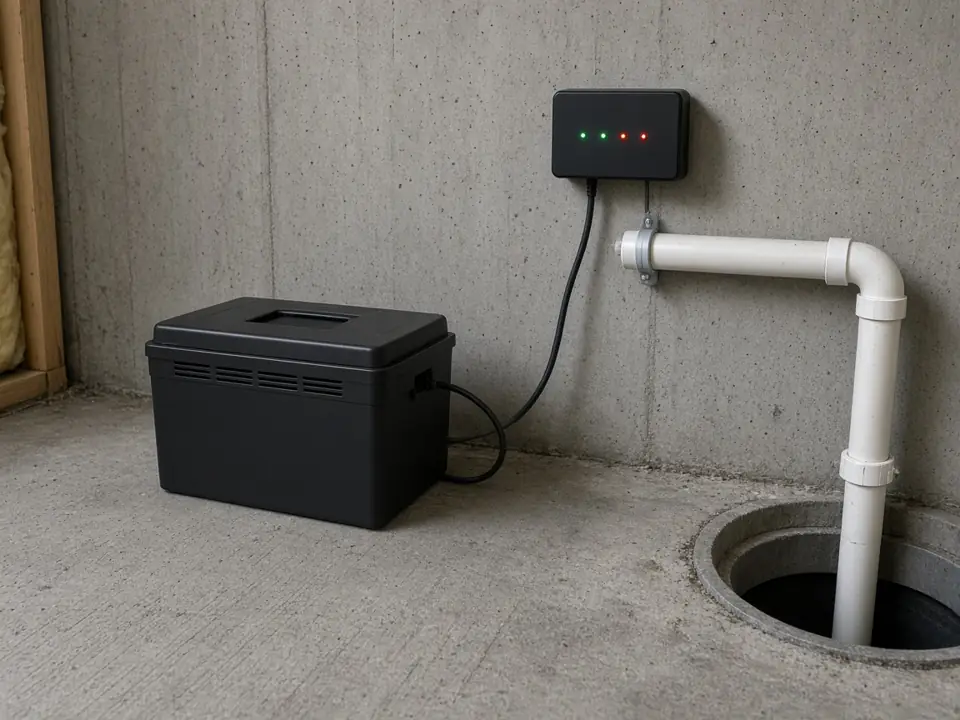
Battery backup vs. water-powered backup
| Battery backup | Water-powered backup | |
|---|---|---|
| Power source | 12V deep-cycle battery with a charger | City water pressure, no electricity |
| Run time | Limited by battery charge | Unlimited as long as city water pressure holds |
| Pumping capacity | Usually decent; varies by model | Lower, and uses roughly 1 gallon of city water for every 1–2 gallons removed |
| Upkeep | Battery every 3–5 years; test regularly | Very little; needs a backflow preventer |
| Best for | Most homes, including those on well water | Homes on city water that want backup with no battery to replace |
Other options
- Combination systems: a primary and a battery backup pump pre-plumbed together, which is tidy for a new install or full replacement.
- Generator: a portable or standby generator can run the primary pump, but someone has to be home to start a portable unit.
- High-water alarm or Wi-Fi alert: not a backup by itself, but it tells you early that something is wrong, which matters when you're at work or out of town.
Good installation details
- The backup pump sits slightly higher in the pit so it only runs when the main pump can't keep up.
- Each pump gets its own check valve so one doesn't pump water back through the other.
- The battery sits in a vented box off the floor, with the charger plugged into its own outlet.
- An audible alarm, and ideally a phone alert, when the backup kicks on.
Typical backup costs
| Option | Typical installed estimate |
|---|---|
| Battery backup pump with battery | $800 – $2,000 |
| Water-powered backup (city water) | $600 – $1,500 |
| Combination primary + backup system | $1,200 – $2,800 |
| Replacement backup battery | $150 – $350 |
All prices are typical West Michigan estimates for planning only. Your actual price depends on your basement, the equipment you choose and the contractor's on-site estimate.
Backup pump questions
How long will a battery backup sump pump run?
It depends on the battery and how often the pump cycles. A typical deep-cycle battery might handle several hours of constant pumping or a day or more of occasional cycling. Manufacturers publish run-time charts; ask the contractor to size it for how often your pit fills in a storm.
How often do backup batteries need replacing?
Typically every 3–5 years. Sealed AGM batteries need little upkeep; flooded batteries need their water level checked. Most backup controllers show battery condition and beep when it's weak.
Can I use a water-powered backup on well water?
Usually not. Water-powered backups need municipal water pressure, typically 40+ psi, and many well pumps stop during a power outage. They also need a backflow preventer, and some local codes have specific rules about them.